Absurd Encounter With Fear, d. David Lynch (USA, 1967)
David Lynch's enigmatic debut film is a mere two minutes long, but manages to be packed with his characteristic mix of horror, humour and unknowable oddness. In it, a blue faced man lumbers across a meadow towards a frightened looking girl. Drawing close to her, he fiddles with his fly and pulls out handfuls of dandelions. The girl is oblivious to what he is doing. When he is finished, he turns to gaze directly at the viewer, and he then collapses, presumably dead.
Lynch died on the 16th of January last year. This world is lousy without him.
In my last post about Quest, I referenced a cosmic chess playing alien gorilla, but neglected to share a screenshot of this entity. This was wrong, and I can only apologise.
On an arid alien planet there is a cave where people live their entire lives in only eight days (although the days do seem quite long and a lot happens in them). After a day of training, a gifted boy is sent out into the world to open a distant gate that will allow his people to emerge into the light and enjoy a more practical life span. Danger, adventure, lasers and a cosmic chess game with an angry gorilla ensue.
Written by Ray Bradbury, directed by the Basses, and made with all the care, attention, imagination and vision that both of those things entail, Quest may be the greatest sci fi short of all time. Actually, I'm going to call it: it is the greatest sci fi short of all time. Please don't write in, I am so unswayable on this I won't even move my eyes across your correspondence.
As with all the best experimental films, it takes a while to twig what's going on with Pat O'Neil's 1967 short film 7362. As the images drift, subdivide and transform like the hot wax blobs in a lava lamp, however, you'll find that it doesn't really matter what you 'get', only what you see and feel.
I'm all for forging ahead with things, but even I have to admit that something has been lost in the press button digital age in terms of experimentation. Analogue was tricky, cumbersome and time-consuming - but it was certainly fun, and it could make even a bunch of old shapes and colours feel new.
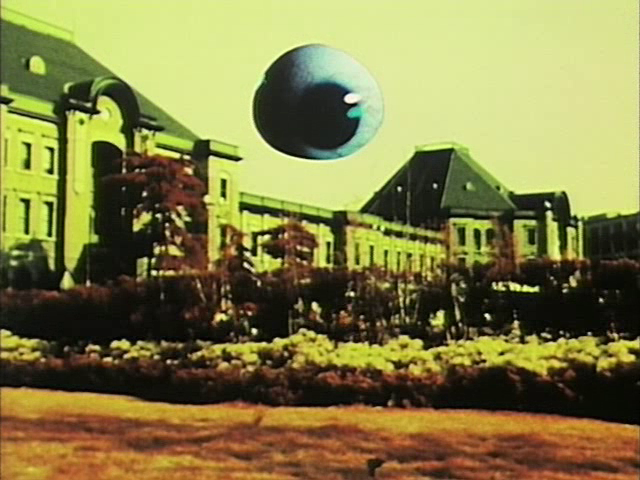
A menacing presence in the sky that calls to mind the constant scrutiny of our CCTV monitored existence. It doesn't seem to bother us much, but then humans have always been surprisingly comfortable with the idea that someone in the sky watches everything we do and silently judges it.
From Tashio Matsumoto's disquieting 1975 experimental short Phantom.
This film, his longest since Six Figures Getting Sick, cost $1,000, and was inspired by his wife Peggy's niece, who once recited the alphabet during a nightmare. A room was painted black and Peggy was painted white to provide a suitably unsettling visual effect. The soundtrack includes a montage of unsettling things like the wind, a siren and a baby crying, all captured on a broken tape recorder.
Alan Resnick is an American
comedian, performance artist, film maker and consciously terrible mime. He
first came to prominence with his Alantutorials, sixty six short films posted
to YouTube that both parodied and celebrated the modern phenomenon of people
making films of how to do stuff,
including simply opening boxes and showing you what’s inside. Resnick plays
Alan, a ‘little kid’ (with massive feet and hands) who uses his phone camera to
make short films in which, for example, he tells us how to put dirt in a box,
crush a can with a piece of wood, spin a salad with an electric drill, or to
glue spray painted coins to an external hard drive. Most of the films are only
two or three minutes long. The tutorials encapsulate the hollow nature of
YouTube: the obsession with gathering likes and subscribers, the impossible yet
oddly achievable dream of becoming an online star via a compulsion to create
content that is neither necessary nor needed. In some of the films, despite
being ostensibly in control of the process, Alan clearly doesn’t have anything
set up, and has to improvise, falling back on staples like lengths of wood,
dirt and ‘water’ that actually resembles antifreeze.
Resnick nails the nascent YouTube
style perfectly: ‘Hi Guys’ or, later, ‘Hi Tutorialheads’ in a soft, high
pitched voice. The films are not badly done, but they are clumsy and unprofessional.
Later on, they will descend into chaos. We never see Alan in person, just bits
of him. He makes the majority of his films on his phone camera, which causes
him problems as many of his tutorials require at least two hands, leading to a
great deal of tragicomic fumbling and his favourite expletive: ‘shoot!’.
The Alantutorials are not simply
clever parodies, they contain a narrative arc. After watching half a dozen or
so, it becomes clear that Alan is not an excitable child, he is an adult with
mental health issues, desperately trying to find some online validation. He
seems lost and alone, and although he sometimes achieves a kind of gleeful
hysteria (usually while being destructive), he is most often unfulfilled or
confused by his own films, prone to accidents and mistakes. Far from being an
expert, he is a rank amateur, not even skilled in the bogus activities he wants
to show us.
The turning point in the series
is when Alan teaches us how to expose the slats of the ceiling and rub the ensuing
dirt onto a bed. This act of destruction has serious consequences. The next
time we see him he is locked out of his room: cold, snivelling and waiting for
someone to come and help him. No-one comes, and Alan is forced to live in the
woods, scavenging for food and water and shelter. Despite these desperate
circumstances, Alan continues with his tutorials, although they now have a
feral, psychotic edge, full of blood and mud and the inexplicable actions of a deranged man in an altered state.
After an uncomfortable period of
mayhem, Alan is next seen locked in the back of a truck and then in what is
first assumed to be a hospital or asylum. But why are there Stanley knives on
the table, why is he allowed to collect his own urine in bottles, and who is
sliding a dollar bill under the door each time he makes a film?
The room becomes dirtier and
dirtier, and Alan becomes more and more unhinged. In the longest episode of the
series, Alan stomps about the piss bottle filled room in a filthy gown, talking
indistinctly to himself and his ‘best friend’, a figure he has fashioned out of
scuzzy looking dollar bills. We can’t hear what he is saying, and we can’t work
out what is happening other than that this perhaps represents Alan’s offscreen
reality: the way he spends his time when he isn’t thinking of his audience. In
the next film, his room is dark and more chaotic than ever. Whatever this
facility is, it has clearly now been abandoned.
A straightforward reading of the
Alantutorials is that they are challenging the evolution of YouTube from an
online platform for individual expression to a corporation owned site that
exploits raw talent in return for relatively small amounts of cash. Is Alan
kidnapped by a company who wish to use his tutorials to direct his audience
towards their own ends, their own products? And is his abandonment the result
of falling figures, or a drive towards a different demographic? Or is all of
this irrelevant, as what we are actually seeing is the inside of Alan’s head,
an elaborate and disturbing fantasy played out online on perhaps the darkest of
all social media channels, the place where irrational people feel most at home,
amongst conspiracy theories, convoluted commentaries, dubious political rants,
strange fetishism and compilations of cleavage shots from ‘Friends’. What
happens here defies interpretation: it’s insanity in all its grubby, self-harming,
self-soiling horror.
To further reinforce the nightmare, and if you can face it, read the comments on Resnick’s YouTube channel, an Escher-esque tumble of opinion
in which people express sympathy for Alan and are then lambasted by others for
not knowing that Alan is not a real person. But is this symptomatic of a
growing split in society? Those who care are criticised for not getting it,
those who do get it are superior and condescending. Just because Alan Resnick
is not Alan Tutorial, does this make the madness any less real? Is it art, or
is it artifice, and what does the fake Alan
say about the real Alan?