Wednesday, 21 August 2024

JEFF KEEN, ALL TIME ART HERO


Jeff Keen (1923-2012) is one of my all time art heroes. Keen was an autodidact who never joined any part of the establishment, not even briefly and, as a result, received none of the attention and accolades due to him as one of the greatest and most original British artists of the 20th century. Posthumously, his reputation has grown, but still not enough. He is one of my biggest influences.

His films are perhaps his primary artform, and they remind you of why Edison called his early cinematic device the Kinetoscope – they are full of motion and energy, crazed, febrile things that burst onto the screen in a barrage of crashing planes, mushroom clouds, plastic soldiers, fires, floods, sexy girls, hairy men, super heroes and super villains, starring his friends and family and set to intriguing and ear popping soundtracks. The young Keen had fought in World War Two (he called it ‘the best time of my life’) and the violence and anarchy of that experience was a major and indelible influence on him.

After leaving the Army, Keen spent a single term at Art College, but was working as a gardener with Brighton Council’s Parks Department when he made his first short film in 1959. A confirmed cineaste, it suddenly occurred to him that he could make a film himself, so he borrowed an 8mm camera and set out on a fifty year career as the UK’s most innovative radical film maker.

Keen’s film work is undeniably experimental, but to me it seems like the product of a parallel universe film industry where horror, sci fi, war and soft porn are the only influences: Hollywood with the boring and talky bits taken out, a gleeful disordering of narrative that goes wherever it likes, however it likes, at 250 miles an hour: comic books, high art, popular cliché and the avant-garde, all delivered in one super fast short burst of energy, like a shot of adrenaline to the heart.

Here are some shots from his 1968 short film White Lite. I find stimulation in every single particle of Keen's work, even the bits 'in-between', where his method creates abstract art without really thinking about it, so eager is he to share his frantic vision. 

I'll get back to Jeff as and when. As I might have mentioned, I love his work.

Friday, 16 August 2024

SEE YOU AT MAO


British Sounds, d. Jean-Luc Godard and Jean-Henri Roger (1970)

Jean-Luc Godard was eight years into a highly successful career when he formed the Dziga-Vertov Group, a loose affiliation of politically charged film makers who, almost certainly, spent most of their time arguing about Chairman Mao and dialectical materialism. 

Named after the influential Soviet film maker Dziga Vertov (perhaps best known for 1929's Man With A Movie Camera), the groups films are defined primarily by their Brechtian forms, Marxist ideology, and a lack of personal authorship. Their time together (1968-1971) resulted in four completed films, the most interesting of which is British Sounds, an experimental film essay that takes in car manufacturing, a naked woman reciting Marx, an upper class fascist blow-hard, a discussion between depressed trade unionists, and a bunch of dippy hippies making posters and trying to rewrite Beatles songs to include revolutionary slogans, a task that is seemingly beyond them.

Angry and uncompromisingly polemical, this film is a bit like being flicked with a wet towel for sixty minutes. It ends with a series of shots of fists punching through the Union Jack, smashing the system, once piece of thin cardboard at a time.

Monday, 12 August 2024

STRANGE MEETING


The early nineteen sixties were a boom period for avant garde film makers. Not only was equipment becoming more affordable and portable, the conventions (and cliches) of the avant garde were not yet fully established, making it a fertile and open period for experimentation. 

In 1963's Sretanje (Encounter) (1963), young Croatian amateur Vladimir Petek gives us a series of shots of a young woman, with the film variously scratched, punctured, drawn on, pixelated, polarised, solarised, cut in half and glued back together in post production to provide a discombobulating and visually rich breaking down of what film can - and is supposed to - do.

Thanks to Jörg for the tip off - and all the other pointers.

Tuesday, 6 August 2024

DANCE AWAY


It's 1969 and, in Canada, hipsters are starting to transform into hippies. Jean Beaudin's psychedelic study Vertige captures a select few - not necessarily freaking out, but certainly cutting a rug with various degrees of commitment. 

Monday, 29 July 2024

FILE UNDER POST PUNK


Everybody has a record in them. It may not be a double album, it may not be any good, but it's there, waiting to be pulled out. The post punk era facilitated many such extractions, from eager and energetic boys and girls who spent a couple of hours and a few quid in a cheap local studio and committed the results to black plastic for future generations to blog about. 

File Under Pop (full irony to be revealed) released a solitary 45, a three track effort where two of the tracks were recorded live at London Heathrow Airport. These tracks are not musical in any conventional sense, consisting of nothing but snatches of ambience, tinny tannoy announcements, overheard conversations and a series of unnerving inorganic noises including at least one electronic arcade game and what sounds like a witch being electrocuted. They are  jarring, badly recorded and compressed to hell, and sound like a space age migraine. I went to Heathrow for the first time in 1978, and its escalators and beige and yellow modernity pretty much blew my ten year old mind, so I completely understand the appeal. 

There is a non-Heathrow track which is the only one where they sound like a 'band'. It consists of a spiky one minute guitar and bass riff over which someone reads quotes from newspapers about Mary Bell (a child who murdered another child) in a Lord Haw Haw voice. How was this not a hit?  

The sleeve features a single light bulb in an otherwise darkened room, a common trope of the era, not least because it looked impressive in monochrome, the colour scheme de l'epoque being predominantly black, white and grey. The lonely light has an undeniably sinister feel, and speaks of tunnels, disused factories, musty cellars, torture chambers, nightmares. It is a light that accentuates the darkness around it rather than illuminating it. 

Thursday, 25 July 2024

WARNING: GRAPHIC CONTENT


The Telidon System (1979-1985 approximately) was a Canadian telephone communication process which enabled the exchange of visual information, a forerunner of Videotex / Teletext and a precursor to advanced computer and game graphics. Developed at a cost of several hundred million dollars, Telidon didn't fulfil its potential and, ultimately, faded away as new developments surged ahead of it.

Pierre Moretti's film Graphic Variations On Telidon, despite sounding like the title of a brainy sci fi parable, showcases the system's ground-breaking capabilities. The visuals are (by current standards) limited, but very charming, with a mid-century feel that reminds me of an etch-a-sketch or the tin plate tube kaleidoscopes which served as entertainment before more spectacular things for kids to look at came along. 

Made in 1980, when hopes for the Telidon were still high, this eight minute film was a product of the National Film Board Of Canada, the greatest of all state run cultural organisations. 

DANCE AWAY


I'm too clumsy and self-conscious to be a dancer, so I try and avoid it wherever I can. Dance, however, is a wonderful thing, even as a spectator sport. In this new intermittent (aren't they all?) series, I'll be posting pictures of people dancing - you can provide your own soundtrack.

Here are some young (and young-ish) Estonian people dancing in a 1980s commercial for, I kid you not, accordions. 

Thursday, 11 July 2024

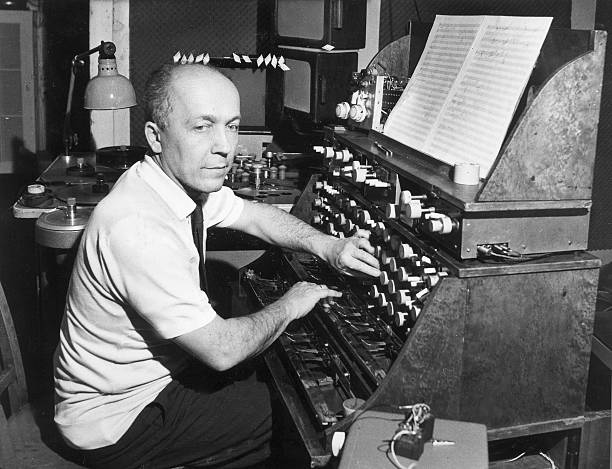
THERE AIN'T NO PARTY LIKE A TRAUTONIUM PARTY


The Trautonium is an electric Synthesizer invented by Friedrich Trautwein in 1930. Trautwein's apprentice,  Oskar Sala, loved the instrument so much that he spent the next 72 years playing it and perfecting its design.

In 1963, Sala used an iteration of the Trautonium to provide the eerie chittering soundscapes that provide the only score for Hitchcock's last masterpiece, The Birds.

A fascinating mix of organ, synth and souped up electric cello, the instrument straddles the olde worlde and the science fiction-y simultaneously and, perhaps unsurprisingly, failed to break into public consciousness. Sadly, since Sala's death in 2002, this labour of love has fallen further into obscurity, with only a handful of people left in the world who know how to play it.

See it, and Sala, in action HERE.

Saturday, 15 June 2024

WISDOM

    
Gillian Wise (1936-2020)

I first saw Wise's work at the Sainsburys Centre in Norwich, the world class art gallery in the grounds of the University of East Anglia, where I studied from 1995 to 1998. I was amazed that these were drawings, and couldn't fathom how they could have been done by hand. I still can't. Magic, probably, or incredible skill.

Despite living only a few hundred metres from the gallery, I suppose I went in about a dozen times over a three year period. Now I'd be in there every single day, mainly because my appreciation of art has increased considerably, partly because I don't have nearly as much on these days.